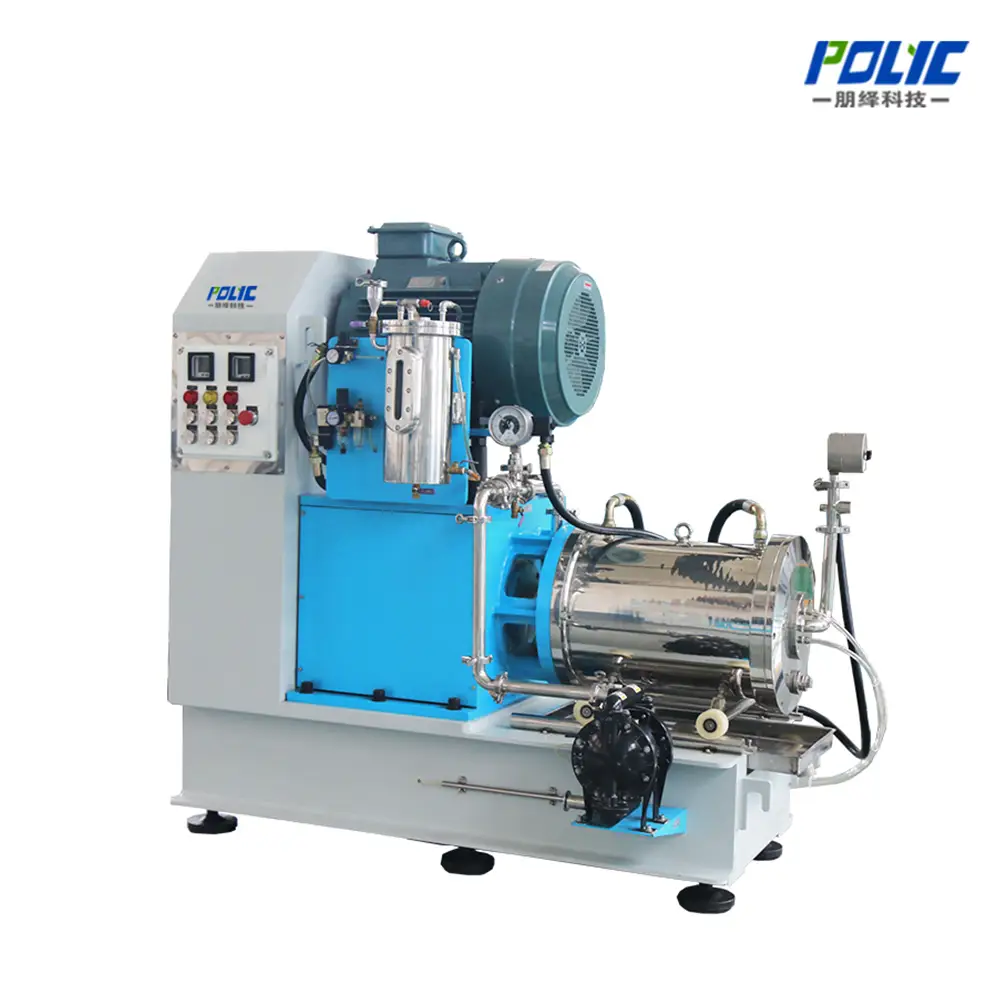
Achieving a stable and uniform dispersion at the nano-scale is a pinnacle of modern material processing, essential for innovations in everything from sunscreens and pharmaceuticals to advanced ceramic coatings and quantum dot inks. It is a task that demands more than just raw power; it requires finesse, precision engineering, and a deep understanding of colloidal science. The Polyc Machine wet bead mill ↗, when specifically configured for this delicate mission, incorporates a suite of essential features. These elements work in concert to overcome the formidable challenges of agglomeration, heat, and contamination, transforming a slurry of raw particles into a sophisticated nano-dispersion of exceptional quality and reliability.
An Agitator Engineered for High-Frequency, High-Intensity Energy
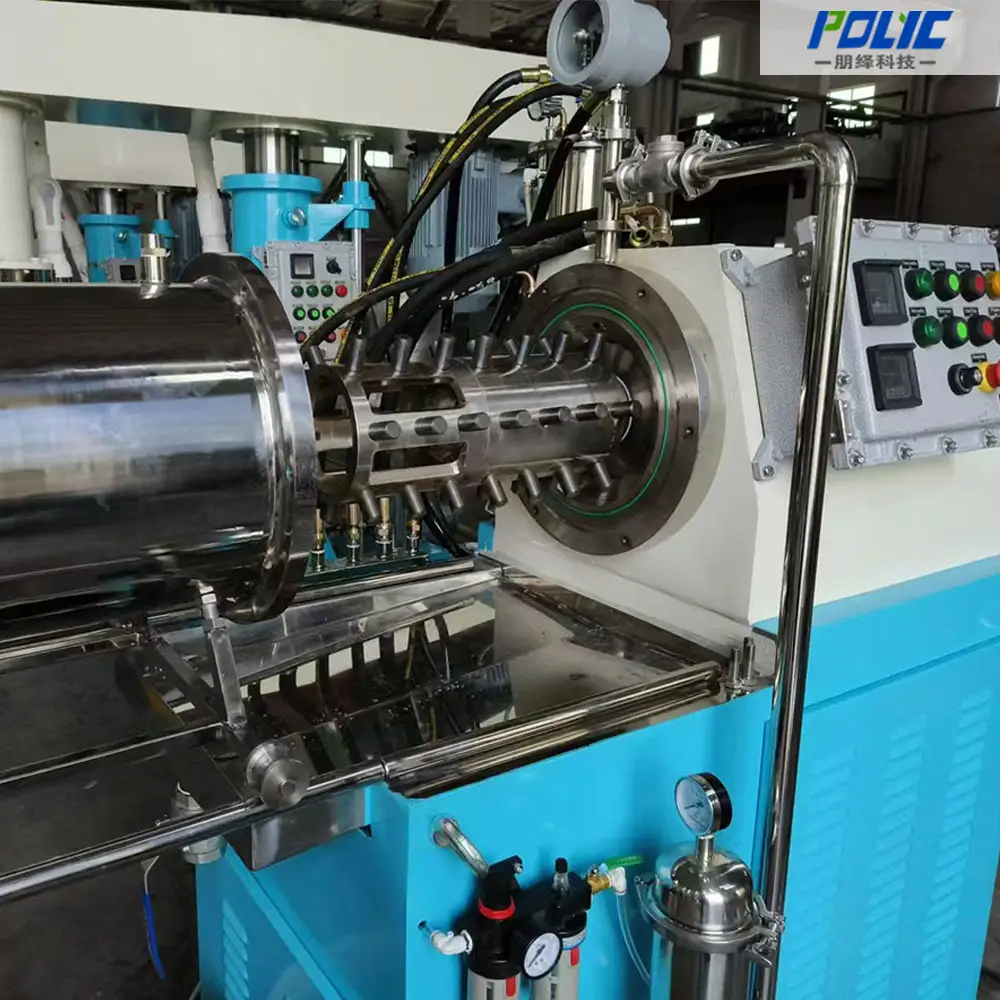
The journey to nano-dispersion begins with the fundamental mechanical action inside the grinding chamber. For this task, a simple rotor is often insufficient. The essential feature here is an advanced, multi-stage agitator system—often a precisely contoured disc stack or pin configuration—designed for optimal energy transfer at high rotational speeds. This geometry creates intense, high-frequency turbulence and shear within the bead bed. It is this relentless, multi-directional mechanical action that provides the necessary force to de-aggregate primary particles and prevent their immediate re-coalescence. The design ensures that energy is not just applied, but applied efficiently and uniformly across the entire slurry volume, making the first critical step toward consistent nano-sizing possible.
 #### Precision-Matched and Ultra-Fine Grinding Media
The beads themselves are not just filler; they are the primary tool. For nano-dispersion, the choice of grinding media becomes hyper-critical. The essential features are extreme small size and exceptional uniformity. Media beads ranging from 0.1mm to 0.3mm in diameter provide the vast number of contact points needed to grind particles down to the nanometer range. Beyond size, the beads must possess high density (often yttria-stabilized zirconia) to deliver sufficient impact force, coupled with extraordinary sphericity and wear resistance. Any deviation in bead size or shape can lead to inconsistent grinding energy and, more disastrously, the generation of media wear debris that could contaminate the nano-dispersion, rendering it useless for sensitive applications.
An Advanced Dynamic Media Separation System
Once the dispersion reaches its target nano-scale, retaining the grinding media within the chamber is an absolute imperative. A traditional screen or gap is a risk point for catastrophic blockage with such fine beads. The non-negotiable feature for safe and continuous nano-grinding is a dynamic, mechanical separation system. This is often a centrifugal gap separator, a rotating component that uses centrifugal force to create a "barrier" that holds back the ultra-fine beads while allowing the viscous nano-slurry to pass through. This system operates without vulnerable screens that can clog, ensuring 100% media retention and uninterrupted production flow, which is vital for both batch consistency and operational safety when processing high-value nano-formulations.
Sophisticated, Multi-Zone Temperature Control
The intense mechanical energy required for nano-dispersion generates significant heat. For many nano-systems—especially those with temperature-sensitive polymers or biologics—even a few degrees of excess temperature can cause gelation, degradation, or unwanted chemical reactions. Therefore, an essential feature is a multi-faceted cooling strategy. This goes beyond a simple cooling jacket. It typically includes precise, high-flow cooling circuits for both the grinding chamber and the agitator shaft, often with independent temperature control zones. Advanced systems may integrate real-time temperature monitoring with feedback loops to the agitator speed, actively managing energy input to maintain the slurry within a critical, narrow thermal window throughout the entire grinding cycle.
Materials of Construction for Ultimate Purity
At the nano-scale, the threat of metallic contamination is magnified. Even trace ions leached from stainless steel components can destabilize a carefully balanced colloidal system or ruin the electrical properties of a conductive nano-ink. The essential material feature is the availability of ceramic or specialized composite wetted parts. A Polyc mill configured for high-purity nano-dispersion may offer a grinding chamber, agitator, and separator crafted entirely from high-alumina ceramic, silicon carbide, or zirconia. These materials offer exceptional hardness, chemical inertness, and near-zero risk of metallic contamination. This ensures the chemical integrity of the nano-particles is preserved, which is fundamental for applications in electronics, biomedicine, and high-end cosmetics.
 #### Scalable and Repeatable Process Parameter Control
Moving a nano-dispersion from a successful 100-gram lab batch to a 500-liter production run is a major technical hurdle. The essential feature that bridges this gap is a control system designed for scalable parameter management. Key variables—such as agitator tip speed, bead load density, flow rate, and temperature—are not just monitored but can be precisely defined and locked into reproducible "recipes." This digital process control ensures that the specific shear history and energy input that successfully created the nano-dispersion in development can be exactly replicated at full scale. This repeatability de-risks scale-up, eliminates costly pilot trials, and guarantees that the exceptional quality defined in the laboratory is embodied in every commercial batch.
A Design Philosophy Centered on Cleanability and Changeover
Finally, because nano-formulations are often high-value and produced in dedicated campaigns, the mill must facilitate impeccable hygiene and rapid product changeovers. Essential features here include a chamber design that allows for complete drainage, smooth, crevice-free internal surfaces, and easy disassembly for manual cleaning or validated clean-in-place (CIP) systems. The ability to quickly and thoroughly purge the system of one product before introducing the next prevents cross-contamination, which is economically and technically critical when alternating between different, highly specialized nano-dispersions. This operational flexibility ensures the mill is not just a processor, but a reliable and agile asset in a multi-product manufacturing environment.
In summary, a Polyc Machine Wet Bead Mill engineered for nano-particle dispersion is defined by these interconnected essential features. From the kinetic energy of its agitator to the purity of its construction materials, each component is purposefully selected and integrated to master the unique triad of challenges in nano-processing: applying immense energy with precision, managing the consequences of that energy, and protecting the exquisite purity of the final product. It is this holistic engineering that transforms the theoretical promise of nanotechnology into a practical, manufacturable reality.